
How to Choose the Right Office Meeting Table
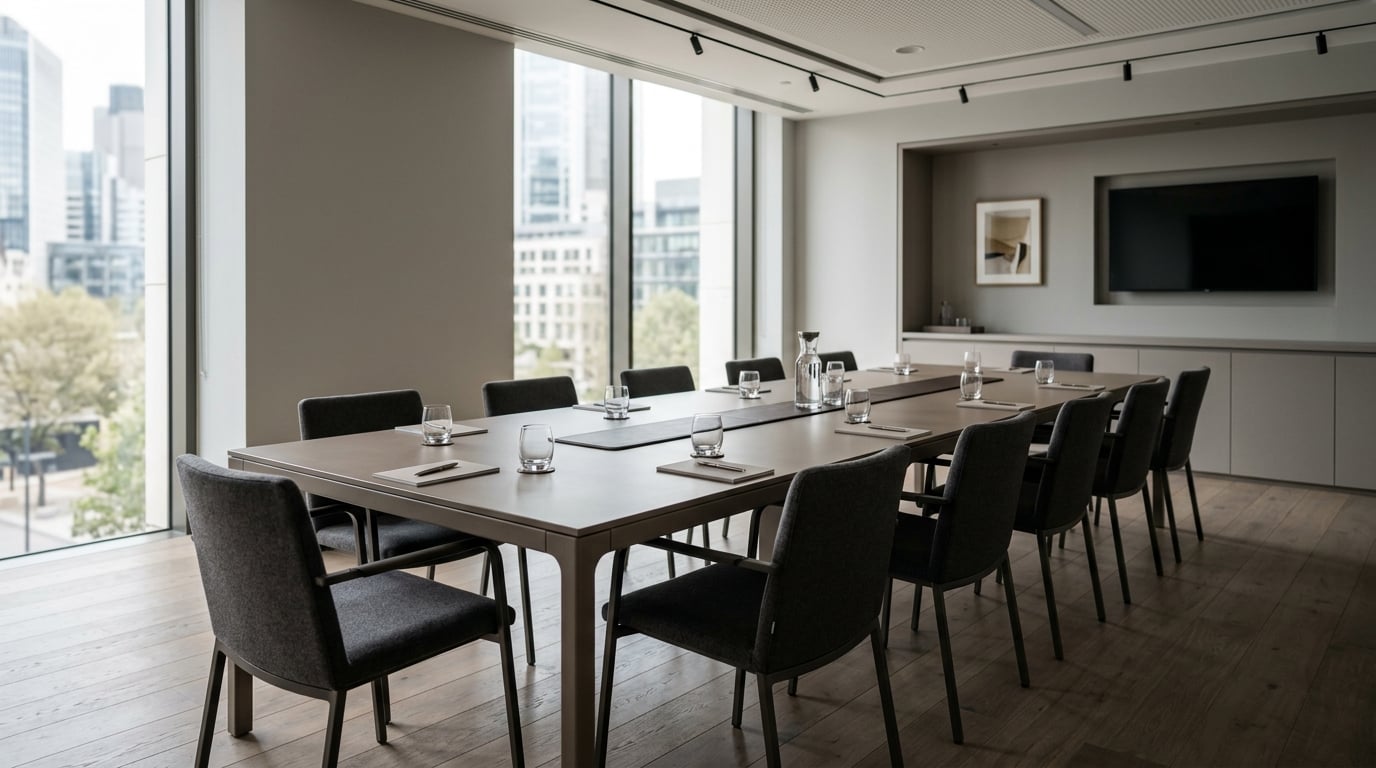
A meeting table is one of the most visible pieces in any workplace, and one of the most used. Getting it right is less about picking a look you like and more about matching the table to the room, the way people meet and the technology they bring to the table. As a design-led British furniture designer we build most meeting tables to configuration, so the decisions below are worth making deliberately rather than defaulting to a standard size.
Start with how the room is actually used
A formal boardroom that hosts board meetings and client presentations has different demands from a project room used for quick stand-ups and collaborative work. Formal rooms reward a single, generous table with a considered finish and integrated power for screens and laptops. Collaborative rooms often work better with lighter tables, sometimes on castors, sometimes flip-top, that can be reconfigured or cleared away entirely.
Match the shape to the conversation
Rectangular tables suit formal, hierarchical meetings and are the most space-efficient for larger groups. Boat-shaped tops narrow slightly at the ends, which improves sightlines to a screen at one end, useful in AV-heavy rooms. Round and square tables encourage equal, discussion-led meetings and work well for four to six people. D-end tables give the formality of a rectangle with a softer finish.
Size the table to the room, not just the seat count
It is easy to specify a table that seats the numbers but leaves no room to move. As a working rule, allow around 600–750mm of table edge per person, and leave at least 900mm of clear space between the table edge and the nearest wall or obstruction so chairs can pull out and people can pass. Our companion size-and-capacity guide sets out typical dimensions for four to twelve seats.
Choose a base that supports the use
Panel and loop bases give a solid, architectural look and hide cable routes well, which suits fixed boardrooms. Four-leg bases are lighter and more flexible. Beam or trestle bases make long tables feel less heavy and can allow more legroom. If the table may be reconfigured, prioritise a base that keeps legs clear of seating positions.
Specify the finish for wear as well as looks
Meeting tables take knocks, hot cups and cleaning. A durable MFC or high-pressure laminate top is practical and comes in a wide palette; a real-wood veneer delivers a premium boardroom feel but needs more care. Our finish guide explains the trade-offs. Whatever you choose, coordinate the top and base finishes with the wider scheme rather than treating the table in isolation.
Plan power and data in from the start
Retro-fitting power is rarely tidy. Decide early whether the table needs in-surface power modules, flip-up units or grommets for cable management, and how those routes reach the floor or wall. A room that hosts video calls should have power positioned for laptops and screens, not as an afterthought.
Work through these five decisions, use, shape, size, base and finish, plus power, and the specification almost writes itself. If you would like help configuring a table for a specific room, our team can advise on dimensions, finishes and lead times.
Planning a project? Our team can help you specify the right products, finishes and lead times.
Talk to our team